
|
Analytical RCM can be used to develop and deliver a series of functioning decision-support tools to
improve the quality of asset management decisions in the electric power industry. Managers
continually make a number of diverse planning and operational decisions concerning various types of
assets. Such decisions can be improved significantly if the reliability characteristics of assets
are directly incorporated in the decision-making process. Since such characteristics are
intrinsically probabilistic, statistical techniques must then be used to develop decision-support
tools. Analytical RCM provides the methodologies and mechanism for developing such tools.
The design and development of decision-support tools capitalize on the availability of data from
the existing sources, e.g., Maintenance Management Workstation (MMW) system and its databases.
Accordingly, the input data will be organized in a series of Microsoft Excel spreadsheets, as the PC is the
platform of choice for these types of decision-support system development.
The tools will be a series of distinct Excel models. These models will be used to deliver outputs
in the following categories.
» Performance indicators
» Forecast of events
» Asset disposition
Performance indicators abstract the reliability characteristics of a specific hardware.
Monitoring of the performance indicators reveals the reliability trends. These indicators
can then be applied to operational data to forecast events. In turn, that forecast coupled
with the number of operational items and status information provides estimates for the volume
of events over a planning horizon. Focusing on events relative to a specific asset along with
the cost of maintaining that asset over time leads to figuring a unit cost, which can be
compared to a unit cost of replacing that asset. Consequently, decisions such as maintain-vs.-replace
can be evaluated.
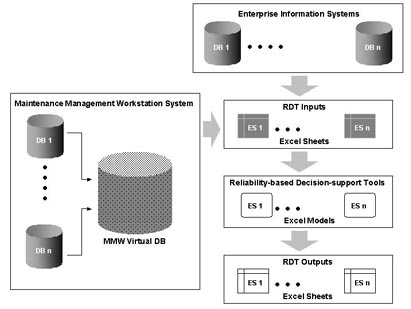
The following figure demonstrates different elements of decision support tool development.
(Click here to view the larger figure)
The expected deliverables include several Excel models that use inputs provided through
MMW and other enterprise databases. The Excel models will then be developed, drawing on the available
input data. The results will be placed in a series of Excel-sheet outputs.

|

